Posts

Showing posts with the label chemistry

O Level Chemistry: A Quick Introduction to the Concept of Ionisation

Image
  O level chemistry introduces students to the fundamental concepts in the subject. One of these concepts is Ionisation. It refers to the process with which an atom or molecule gains or loses electrons for forming ions, which are charged particles. You might wonder why the study of this process is crucial in your O level curriculum. The truth is this transformation serves a major role in the understanding of chemical reactions, properties of substances and chemical bonding. Before you get to learn this key chapter in your school or chemistry tuition centre, we give you a quick introductory lesson on ionisation. Keep reading till the end to know the basics of this concept. What is Ionisation? It is the process by which an atom or molecule acquires a negative or positive charge by adding or losing electrons. This results in the formation of ions. The process can happen in various ways such as by the application of energy or chemical reactions. If the atom loses electrons then it be...

Breaking the Code of Atomic Mass to Gain Knowledge of the The key Unit of Matter

Image
  Within the enthralling universe of microscopic marvels, where the commonplace gives way to the extraordinary, the mysterious notion of atomic mass comes under the spotlight. Imagine it as the heavyweight champion of the invisible realm, the cosmic weightlifting champion on the subatomic stage. The secret to unlocking the mysteries of matter is atomic mass, the unsung hero of the microscopic ballet. So buckle up and join us on an exciting journey to solve the riddles woven into the very fabric of the universe – the fascinating realm of atomic mass. And fear not, for our cosmic guide through this subatomic maze is none other than the wizardry of chemistry tuition , ensuring that the intricacies of this microscopic ballet become as clear as the starlit night sky. Understanding Atomic Mass: At the heart of every substance, from the air we breathe to the stars that twinkle in the night sky, lies the essence of atomic mass. But what exactly is atomic mass? Imagine the nucleus of an ato...

The Many Faces of Chemical Reactions: Types and Variations

Image
Everything we see, touch, and experience in the world around us is a result of chemical processes. Chemical reactions are the driving force behind everything, from the fuel combustion that powers our cars to the biological mechanisms that keep life alive. To better comprehend the fundamental processes that affect our universe, we will explore the sorts of chemical reactions in this blog article and provide examples from everyday life. We'll also talk about how taking chemistry tuition might help you understand this interesting subject better. Basic of Chemical Reactions Before we dive into the different types of chemical reactions, let's establish a basic understanding of what a chemical reaction is. At its core, a chemical reaction is a process in which one or more substances (reactants) undergo a transformation to produce new substances (products). During a chemical reaction, chemical bonds are broken and formed, resulting in the rearrangement of atoms and the creation of ne...

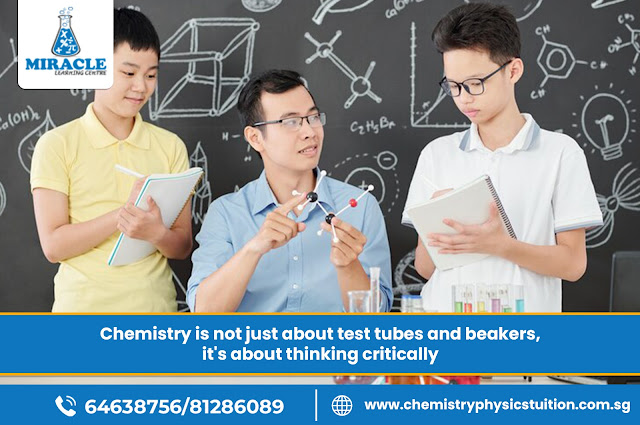
The Role of Chemistry Tuition in Developing Critical Thinking

Image
  Chemistry, often dubbed the "central science," plays a pivotal role in our understanding of the natural world. However, mastering this subject can be a daunting task for many students. Its complex concepts and abstract theories often leave learners struggling to connect the dots. One effective way to bridge this gap and enhance one's grasp of chemistry is through chemistry tuition . In places like Singapore, where education is highly valued, tuition services have emerged as invaluable resources. These services not only provide subject-specific knowledge but also nurture critical thinking skills, making chemistry more accessible and enjoyable. What Makes Chemistry So Challenging? Chemistry's intricacies lie in its multifaceted nature. It delves into the composition, structure, properties, and transformations of matter, demanding a deep understanding of abstract concepts and their real-world applications. The periodic table, chemical reactions, and equations can often...